Climate Change Impacts
Climate change is a global problem that can greatly affect even small ecosystems. Some causes of climate change include mass agricultural practices, large levels of deforestation, and emissions. It also involves the degradation of the ozone layer which protects the Earth from harmful UV rays, with the holes made from pollution the layer has a harder time regulating temperature. This creates a general temperature increase of the planet, which leads to more extreme weather conditions and changing of regional weather patterns. The reduction of biodiversity is another problem that is expedited by climate change. Invasive species can more easily adapt to the changing weather than sensitive species, diseases can readily spread among plant and animal populations.
It is not just the environment alone that is affected by climate change but also humans and our livelihoods. Below you can explore how climate change has negatively effected our infrastructure, fisheries, health, and agricultural practices.
-
Infrastructure
-
Fisheries
-
Human Health
-
Agriculture
<
>
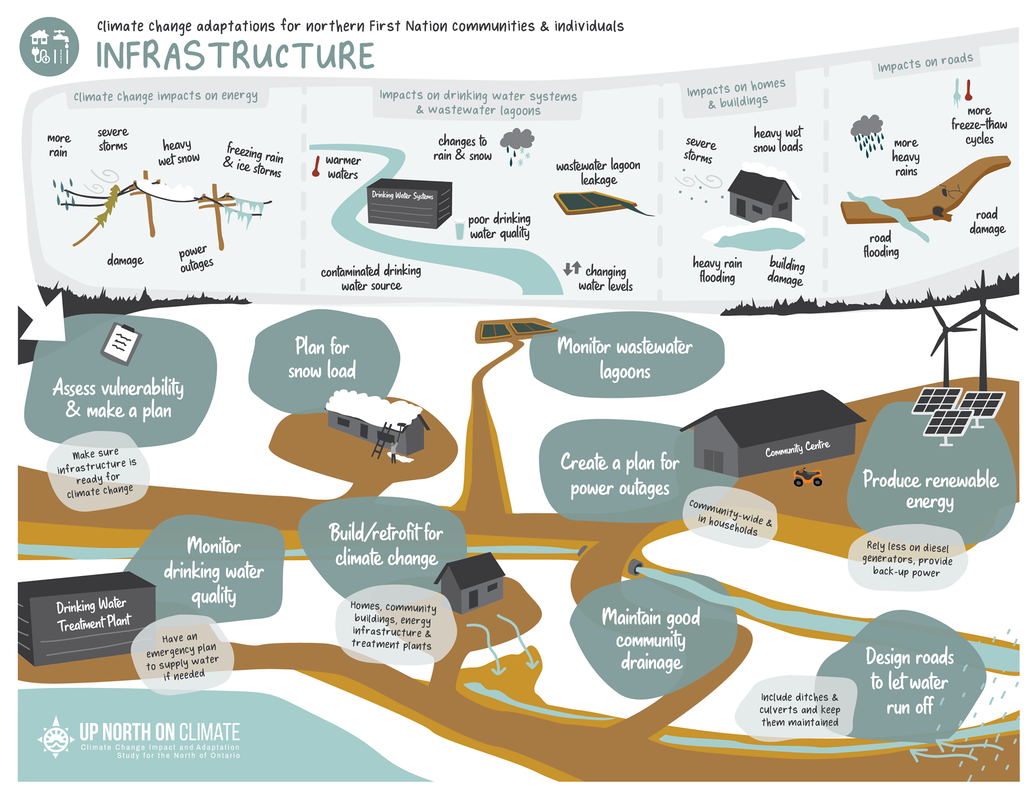
Climate change can impact important parts of our communities; roads can be damaged by heavy rain or freeze-thaw cycles, power lines can get toppled from strong winds or freezing rain, and our homes can be put to the test by severe storms or heavy snow loads. In remote First Nation communities where supplies for repair might not be readily available, these impacts can be even more challenging.
Start the conversation about adaptation!
Explore the graphic below for actions people and communities can take to help weather the storm as community infrastructure is challenged by climate change. Share it with others to start the conversation about adaptation in your community!
Find more information and download the 2-sided graphic on our website at
https://www.upnorthonclimate.ca/preparing-infrastructure
Start the conversation about adaptation!
Explore the graphic below for actions people and communities can take to help weather the storm as community infrastructure is challenged by climate change. Share it with others to start the conversation about adaptation in your community!
Find more information and download the 2-sided graphic on our website at
https://www.upnorthonclimate.ca/preparing-infrastructure

Warming water temperatures could increase the depth of the thermocline altering the amount of appropriate thermal habitat for fish.
Increase in warm water habitat. This could mean that Largemouth Bass may become established in more lakes on Manitoulin and that lakes that already contain Bass species will be able to support more of these fish.
Longer periods of stratification without mixing could lead to the development of a hypoxic or even anoxic zone at the bottom of lakes.
An increase in productivity could lead to an increase in algal growth some of which contain toxins harmful to fish.
If prey availability increases, an increase in metabolic rate due to warmer water would lead to faster and larger growth of fishes. If prey availability remains the same or decreases fish growth will be stunted.
Increase in warm water habitat. This could mean that Largemouth Bass may become established in more lakes on Manitoulin and that lakes that already contain Bass species will be able to support more of these fish.
- If lakes become more suitable for Bass species, their numbers could increase which has the potential to lead to an increase in competition leading to stunted growth. (More Bass but smaller Bass)
- In lakes where Walleye and Bass are both present the number of Walleyes decreases significantly compared to lakes with just Walleye. If Bass populations increase in size it could lead to a decrease in the numbers of Walleye.
- An increase in competition due to decreasing habitat size could lead to the extirpation of the less successful species and eventual stunted growth of the surviving species.
- If cold water fish are forced to search for food outside of their optimum thermal range, it could negatively affect their metabolism and rate of growth leading to smaller cold-water fish.
Longer periods of stratification without mixing could lead to the development of a hypoxic or even anoxic zone at the bottom of lakes.
- Without adequate oxygen supply this could lead to the death of cold-water fish species in deeper lakes or it could force cold water fish into suboptimal thermal guilds leading to stunted growth.
An increase in productivity could lead to an increase in algal growth some of which contain toxins harmful to fish.
- Smaller bait-fish are more susceptible to toxins in the water, and an increase in HAB’s could lead to the loss of prey species within lakes (especially small shallow lakes) which could lead to decreased population size or stunted growth of larger sport fish.
- An increase in toxic algal blooms could even lead to the deaths of larger sport fish given the size and extent of HAB’s.
- An increase in nutrient loading, primary productivity and algal growth will lead to an increase in decomposing organic material. This reduces the amount of dissolved oxygen within a lake and can lead to fish-kill or die-off. Smaller, shallow lakes are especially susceptible to this throughout the winter when the organic matter decomposes beneath the ice.
If prey availability increases, an increase in metabolic rate due to warmer water would lead to faster and larger growth of fishes. If prey availability remains the same or decreases fish growth will be stunted.
- Because fish can move throughout the water and can thermoregulate by finding the optimal thermal guild certain species will be more effected. In deeper lakes there is more depth for cold water fish to find the optimal thermal guild and therefore these fish will not experience as great of a temperature change as cool water fish in shallower lakes. For example, Yellow Perch a cool-water fish is expected to experience greater decreases in growth compared to Whitefish a cold-water fish under constant or reduced prey availability.
- Changes in spawning time could lead to reduced success of eggs and juveniles due to predation of other fish species that may become more active under warmer temperatures.
- Fish species such Cisco and Whitefish lay their eggs in nearshore environments in the early winter. Warmer temperatures leading to reduced ice cover could increase the amount of wave action in nearshore environments leading to reduced success of these species.
Increasing air temperatures and changing precipitation patterns have the potential to lead to the northward movement of zoonotic and vector-borne diseases. The current trends also have the potential to exacerbate zoonotic and vector-borne diseases that are already present.
Manitoulin Island had its first confirmed occurrence of the Black Legged Tick in 2017. However, it did not test positive for the bacteria causing Lyme Disease.
In 3 of the last 4 years Sudbury has had Black Legged Ticks test positive for Lyme Disease.
Certain species of Mosquitos on Manitoulin can carry the West Nile Virus which they pick up from birds. This virus can be transferred to humans, horses and other mammals.
Gore Bay
On average, Gore Bay had 2.1 days per year with temperatures exceeding 30 °C between 1981-2010. By the 2080’s it is projected that Gore Bay will experience 38.5 days per year with temperatures exceeding 30 °C.
Little Current
On average, Little Current had 1.5 days per year with temperatures exceeding 30 °C between 1981-2010. By the 2080’s it is projected that Little Current will experience 33.1 days per year with temperatures exceeding 30 °C.
South Baymouth
On average, South Baymouth had 0.5 days per year with temperatures exceeding 30 °C between 1981-2010. By the 2080’s it is projected that South Baymouth will experience 24.1 days per year with temperatures exceeding 30 °C.
An increase in air temperatures is likely to lead to an increase in heat-related illness such as exhaustion and heat stroke.
It is also expected that existing medical conditions related to respiratory, circulatory and nervous system health will be worsened by increasing air temperatures.
An increase in water temperatures could lead to an increase in the amount of algae growth and has the potential to increase the amount of harmful algae blooms that produce toxins.
Manitoulin Island had its first confirmed occurrence of the Black Legged Tick in 2017. However, it did not test positive for the bacteria causing Lyme Disease.
In 3 of the last 4 years Sudbury has had Black Legged Ticks test positive for Lyme Disease.
- It is suspected that the ticks are transported by the movement of migratory birds. Manitoulin is in the middle of a major flyway for a large number of migratory birds.
- Black Legged Tick’s go dormant when temperatures drop below 2 °C and will die off when temperatures drop below -12 °C and stay that way for several days.
Certain species of Mosquitos on Manitoulin can carry the West Nile Virus which they pick up from birds. This virus can be transferred to humans, horses and other mammals.
- Increased Summer and Fall air temperatures can increase the growth rate of mosquito populations, decrease the time interval between mosquito feeding, shorten the time from infection to infectiousness in mosquitoes, accelerate the rate of virus evolution and increase the efficiency of viral transmission to birds.
- Increased precipitation has the potential to increase the amount of standing water during the spring which could lead to higher mosquito abundance. However, increased spring precipitation could also flush mosquito larva out the drainage areas and ditches they typically breed in as well as diluting the amount of organic matter the larva needs to grow.
- Increased evaporation due to increased summer temperatures could lead to outbreaks of certain mosquito species as it concentrates organic matter in the standing water that remains. During drought conditions the interaction between birds and mosquitos increases as they both concentrate around the remaining standing water which accelerates the cycling and amplification of West Nile Virus within these populations.
Gore Bay
On average, Gore Bay had 2.1 days per year with temperatures exceeding 30 °C between 1981-2010. By the 2080’s it is projected that Gore Bay will experience 38.5 days per year with temperatures exceeding 30 °C.
Little Current
On average, Little Current had 1.5 days per year with temperatures exceeding 30 °C between 1981-2010. By the 2080’s it is projected that Little Current will experience 33.1 days per year with temperatures exceeding 30 °C.
South Baymouth
On average, South Baymouth had 0.5 days per year with temperatures exceeding 30 °C between 1981-2010. By the 2080’s it is projected that South Baymouth will experience 24.1 days per year with temperatures exceeding 30 °C.
An increase in air temperatures is likely to lead to an increase in heat-related illness such as exhaustion and heat stroke.
It is also expected that existing medical conditions related to respiratory, circulatory and nervous system health will be worsened by increasing air temperatures.
An increase in water temperatures could lead to an increase in the amount of algae growth and has the potential to increase the amount of harmful algae blooms that produce toxins.
- Blue green algae prefer warmer water temperatures and grow thicker and faster when there is little mixing due to increased periods of stratification.
- Small organisms can move faster in warm water which could allow for algae to float to the surface faster, where they can absorb heat radiation from the sun further warming water temperatures and exacerbating algal blooms.
- Algae require Carbon dioxide to survive and higher levels of it in the air and water can lead to rapid growth of algae.
- An increase in Spring and Fall precipitation with more drought conditions in the Summer can lead to massive nutrient run-off occurring all at once which increases algae growth.
Crops
Manitoulin is relatively protected by Lake Huron so the climate trends we’re experiencing will not likely be a huge detriment to crops and only minor changes would be required.
The biggest change that may be required is increasing the number of fields with tile drainage to deal with increased spring precipitation.
With tile drainage, crops can be planted earlier in the spring so they have enough time to establish root systems to help deal with summer drought conditions.
Hay is the most grown crop on Manitoulin and it along with winter wheat are particularly susceptible to winter kill.
With increased winter precipitation in the form of rain, the ground could be covered in layers of ice rather than the typical snow pack. This prevents oxygen from getting to the plants and could lead to increased winter kill.
An increase in the freeze thaw cycle can cause the roots of overwintering hay to be drowned.
While the winters may be more difficult for hay, a warmer and wetter spring could be beneficial in terms of growth.
A decrease in summer precipitation or an increase in summer evaporation due to increased air temperatures could slow the growth and reduce the yield of these plants.
Barley and oats grow best in cooler climates so an increase in summer air temperatures could also reduce growth on its own regardless of precipitation.
Legumes establish deeper roots and will be better suited to dealing with summer drought conditions.
However, legumes are also susceptible to winter kill and it may be necessary to keep an updated stand that's tilled every 4-5 years.
The number of frost-free days and the number of growing degree days (GDD) are predicted to increase across Manitoulin which is an overall benefit for crop agriculture.
Gore Bay
Livestock
Manitoulin is relatively protected by Lake Huron so the climate trends we’re experiencing will not likely be a huge detriment to crops and only minor changes would be required.
The biggest change that may be required is increasing the number of fields with tile drainage to deal with increased spring precipitation.
With tile drainage, crops can be planted earlier in the spring so they have enough time to establish root systems to help deal with summer drought conditions.
Hay is the most grown crop on Manitoulin and it along with winter wheat are particularly susceptible to winter kill.
With increased winter precipitation in the form of rain, the ground could be covered in layers of ice rather than the typical snow pack. This prevents oxygen from getting to the plants and could lead to increased winter kill.
An increase in the freeze thaw cycle can cause the roots of overwintering hay to be drowned.
While the winters may be more difficult for hay, a warmer and wetter spring could be beneficial in terms of growth.
- Preventative measures could include increased seeding in the Fall as well as earlier planting.
A decrease in summer precipitation or an increase in summer evaporation due to increased air temperatures could slow the growth and reduce the yield of these plants.
Barley and oats grow best in cooler climates so an increase in summer air temperatures could also reduce growth on its own regardless of precipitation.
- Preventative measures could include earlier planting to avoid extreme heat and lack of precipitation.
- If springs are expected to be extremely wet having tiled land would also be a benefit.
Legumes establish deeper roots and will be better suited to dealing with summer drought conditions.
However, legumes are also susceptible to winter kill and it may be necessary to keep an updated stand that's tilled every 4-5 years.
The number of frost-free days and the number of growing degree days (GDD) are predicted to increase across Manitoulin which is an overall benefit for crop agriculture.
Gore Bay
- From 1981-2010 Gore Bay had on average 209 frost free days per year. By the 2080’s it is expected there will be on average 276 frost free days.
- From 1981-2010 Gore Bay had on average 1813.7 GDD. By the 2080’s it is expected there will be on average 3006.4 GDD per year.
- From 1981-2010 Little Current had on average 204 frost free days per year. By the 2080’s it is expected there will be on average 273 frost free days.
- From 1981-2010 Little Current had on average 1741.7 GDD. By the 2080’s it is expected there will be on average 2917 GDD per year.
- From 1981-2010 South Baymouth had on average 218 frost free days per year. By the 2080’s it is expected there will be on average 289 frost free days.
- From 1981-2010 South Baymouth had on average 1761.4 GDD. By the 2080’s it is expected there will be on average 2988 GDD per year.
Livestock
- Heat stress is unlikely to be a major health issue unless cattle have zero access to shade. The water consumption of cattle may increase and more grazing may occur during cooler periods of the day. If it is too hot bulls will not breed and the calving season may be delayed. Planting trees or allowing for bush access to provide shade could be a preventative measure
- If calving occurs in the winter or spring and there is a lot of temperature fluctuation, calves may be more susceptible to illness and respiratory issues like pneumonia. Wetter springs could also lead to an increase in scours, naval infection and foot rot. Wet springs lead to more flies which are stressor for cattle and if extreme summer temperatures are added on top of that as well as moving cattle, it could lead to a reduction in weight gain.
- Higher temperatures could mean that sheep require shearing twice a year as opposed to once in order to reduce heat stress. If the spring is also particularly wet there will be more flies which lay eggs in the wool of sheep and the maggots could begin eating the sheep.
For more information on climate change check out these links!
The Effects of Climate Change
The Climate Crisis
The Basics
The Effects of Climate Change
The Climate Crisis
The Basics